Flag of the United States

July 4, 1960 (current 50-star version)
The national flag of the United States of America (or the American flag) consists of thirteen equal horizontal stripes of red (top and bottom) alternating with white, with a blue rectangle in the canton (referred to specifically as the "union") bearing fifty small, white, five-pointed stars arranged in nine offset horizontal rows of six stars (top and bottom) alternating with rows of five stars.
Iconic meaning
The modern meaning of the flag was forged in December 1861 when Major Robert Anderson, acting without orders, moved the American garrison from Fort Moultrie to Fort Sumter, in Charleston Harbor, in defiance of the power of the new Confederate States of America. Goodheart argues this was the opening move of the Civil War, and the flag was used throughout the North to symbolize American nationalism and rejection of secessionism.
Before that day, the flag had served mostly as a military ensign or a convenient marking of American territory, flown from forts, embassies, and ships, and displayed on special occasions like the Fourth of July. But in the weeks after Major Anderson's surprising stand, it became something different. Suddenly the Stars and Stripes flew – as it does today, and especially as it did after September 11 – from houses, from storefronts, from churches; above the village greens and college quads. For the first time American flags were mass-produced rather than individually stitched and even so, manufacturers could not keep up with demand. As the long winter of 1861 turned into spring, that old flag meant something new. The abstraction of the Union cause was transfigured into a physical thing: strips of cloth that millions of people would fight for, and many thousands die for. [ 3 ]


The flag of the United States is one of the nation's most widely recognized symbols. Within the United States, flags are frequently displayed not only on public buildings but on private residences. The flag is a common motif on decals for car windows, and clothing ornaments such as badges and lapel pins. Throughout the world the flag has been used in public discourse to refer to the United States, not only as a nation, state, government, and set of policies, but also as a set of ideals.
The flag has become a powerful symbol of Americanism, and is proudly flown on many occasions, with giant outdoor flags used by retail outlets to draw customers. Desecration of the flag is considered a public outrage, but remains protected as freedom of speech. In worldwide comparison, Testi (2010) notes that the United States is not unique in adoring its banner, for in Scandinavian countries their flags are also "beloved, domesticated, commercialized and sacralized objects" [ 4 ]
Specifications
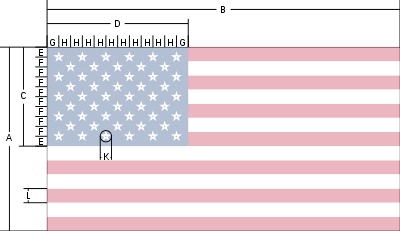
The basic design of the current flag is specified by 4 U.S.C. § 1; 4 U.S.C. § 2 outlines the addition of new stars to represent new states. The specification gives the following values:
- Hoist (width) of the flag: A = 1.0
- Fly (length) of the flag: B = 1.9 [ 5 ]
- Hoist (width) of the Union: C = 0.5385 (A × 7/13, spanning seven stripes)
- Fly (length) of the Union: D = 0.76 (B × 2/5, two fifths of the flag length)
- E = F = 0.0538 (C/10, One tenth of the width of the Union)
- G = H = 0.0633 (D/12, One twelfth of the length of the Union)
- Diameter of star: K = 0.0616
- Width of stripe: L = 0.0769 (A/13, One thirteenth of the flag width)
These specifications are contained in an executive order which, strictly speaking, governs only flags made for or by the U.S. federal government. [ 6 ] In practice, most U.S. national flags available for sale to the public have a different length-to-width ratio; common sizes are 2 × 3 ft. or 4 × 6 ft. (flag ratio 1.5), 2.5 × 4 ft. or 5 × 8 ft. (1.6), or 3 × 5 ft. or 6 × 10 ft. (1.667). Even flags flown over the U.S. Capitol for sale to the public through Representatives or Senators are provided in these sizes. [ 7 ] Flags that are made to the prescribed 1.9 ratio are often referred to as "G-spec" (for "government specification") flags.
The exact red, white, and blue colors to be used in the flag are specified with reference to the CAUS Standard Color Reference of America, 10th edition. Specifically, the colors are "White", "Old Glory Red", and "Old Glory Blue". [ 8 ] The CIE coordinates for the colors of the 9th edition of the Standard Color Card were formally specified in JOSA in 1946. [ 9 ] These colors form the standard for cloth, and there is no perfect way to convert them to RGB for display on screen or CMYK for printing. The "relative" coordinates in the following table were found by scaling the luminous reflectance relative to the flag’s "white".

As with the design, the official colors are only officially required for flags produced for the U.S. federal government, and other colors are often used for mass-market flags, printed reproductions, and other products intended to evoke flag colors. The practice of using more saturated colors than the official cloth is not new. As Taylor, Knoche, and Granville wrote in 1950: "The color of the official wool bunting [of the blue field] is a very dark blue, but printed reproductions of the flag, as well as merchandise supposed to match the flag, present the color as a deep blue much brighter than the official wool." [ 11 ]
Sometimes, Pantone Matching System (PMS) approximations to the flag colors are used. One set was given on the website of the U.S. embassy in London as early as 1998; the website of the U.S. embassy in Stockholm claimed in 2001 that those had been suggested by Pantone, and that the U.S. Government Printing Office preferred a different set. A third red was suggested by a California Military Department document in 2002. [ 12 ] In 2001, the Texas legislature specified that the colors of the Texas flag should be "(1) the same colors used in the United States flag; and (2) defined as numbers 193 (red) and 281 (dark blue) of the Pantone Matching System." [ 13 ]
The 49- and 50-star unions
When Alaska and Hawaii were being considered for statehood in the 1950s, more than 1,500 designs were spontaneously submitted to President Dwight D. Eisenhower. Although some of them were 49-star versions, the vast majority were 50-star proposals. At least three of these designs were identical to the present design of the 50-star flag. [ 15 ] At the time, credit was given by the executive department to the United States Army Institute of Heraldry for the design.
Of these proposals, one created by 17-year-old Robert G. Heft in 1958 as a school project has received the most publicity. His mother was a seamstress, but refused to do any of the work for him. He originally received a B- for the project. After discussing the grade with his teacher, it was agreed (somewhat jokingly) that if the flag was accepted by Congress, the grade would be reconsidered. Heft's flag design was chosen and adopted by presidential proclamation after Alaska and before Hawaii was admitted into the union in 1959. [ 16 ] Both the 49- and 50-star flags were each flown for the first time ever at Fort McHenry on the Fourth of July one year apart, 1959 and 1960 respectively. [ 17 ]
Decoration
Traditionally, the flag may be decorated with golden fringe surrounding the perimeter of the flag as long as it does not deface the flag proper. Ceremonial displays of the flag, such as those in parades or on indoor posts, often use fringe to enhance the beauty of the flag. The first recorded use of fringe on a flag dates from 1835, and the Army used it officially in 1895. No specific law governs the legality of fringe, but a 1925 opinion of the attorney general addresses the use of fringe (and the number of stars) ". is at the discretion of the Commander in Chief of the Army and Navy. " as quoted from footnote in previous volumes of Title 4 of the United States Code law books and is a source for claims that such a flag is a military ensign not civilian. However, according to the Army Institute of Heraldry, which has official custody of the flag designs and makes any change ordered, there are no implications of symbolism in the use of fringe. [ 18 ] Several federal courts have upheld this conclusion. [ 19 ] [ 20 ] Traditionally, the Army and Air Force use a fringed National Color for parade, color guard and indoor display, while the Sea Services (Navy, Marine Corps and Coast Guard) use a fringeless National Color for all uses.
Display and use

The flag is customarily flown all year-round at most public buildings, and it is not unusual to find private houses flying full-size flags. Some private use is year-round, but becomes widespread on civic holidays like Memorial Day, Veterans Day, Presidents' Day, Flag Day, and on Independence Day. On Memorial Day it is common to place small flags by war memorials and next to the graves of U.S. war veterans. Also on Memorial Day it is common to fly the flag at half staff, until noon, in remembrance of those who lost their lives fighting in U.S. wars.
Flag etiquette

The United States Flag Code outlines certain guidelines for the use, display, and disposal of the flag. For example, the flag should never be dipped to any person or thing, unless it is the ensign responding to a salute from a ship of a foreign nation. This tradition may come from the 1908 Summer Olympics in London, where countries were asked to dip their flag to King Edward VII: the American flag bearer did not. Team captain Martin Sheridan is famously quoted as saying "this flag dips to no earthly king", though the true provenance of this quotation is unclear. [ 21 ] [ 22 ]

The flag should never be allowed to touch the ground and, if flown at night, must be illuminated. If the edges become tattered through wear, the flag should be repaired or replaced. When a flag is so tattered that it can no longer serve as a symbol of the United States, it should be destroyed in a dignified manner, preferably by burning. The American Legion and other organizations regularly conduct flag retirement ceremonies, often on Flag Day, June 14. It is a common myth that if a flag touches the ground or becomes soiled, it must be burned as well. While a flag that is currently touching the ground and a soiled flag are unfit for display, neither situation is permanent and thus the flag does not need to be burned if the unfit situation is remedied. [ 23 ]
Significantly, the Flag Code prohibits using the flag "for any advertising purpose" and also states that the flag "should not be embroidered, printed, or otherwise impressed on such articles as cushions, handkerchiefs, napkins, boxes, or anything intended to be discarded after temporary use". [ 24 ] Both of these codes are generally ignored, almost always without comment.
One of the most commonly ignored and misunderstood aspects of the Flag Code is section 8. "The flag should never be used as wearing apparel, bedding, or drapery." Section 3 of the Flag Code [ 25 ] defines a flag for the purposes of the code. It clarifies the definition to include any picture or representation of the flag purporting to be of the flag of the United States of America. Therefore T-shirts, or other apparel made of or containing a representation of the flag are in violation of the code.
Although the Flag Code is U.S. federal law, it is only binding on government institutions displaying the flag: there is no penalty for a private citizen or group failing to comply with the Flag Code and it is not widely enforced—indeed, punitive enforcement would conflict with the First Amendment right to freedom of speech. [ 26 ] Passage of the proposed Flag Desecration Amendment would overrule legal precedent that has been established.
Display on vehicles and uniforms

When the flag is affixed to the side of a vehicle, it should be oriented so that the union is towards the front. This is done to give the impression that the flag is blowing backwards from its hoist as the vehicle moves forward. Therefore, U.S. flag decals on the right sides of vehicles may appear to be "reversed", with the union to the observer's right instead of left as more commonly seen.
On U.S. military uniforms, flag patches are oriented the same way, that is, on the right shoulder with the union toward the front. This rule dates back to the Army's early history, when both mounted cavalry and infantry units would designate a standard bearer, who carried the Colors into battle. As he charged, his forward motion caused the flag to stream back. Since the Stars and Stripes are mounted with the canton closest to the pole, that section stayed to the right, while the stripes flew to the left. [ 27 ]
Other organizations that wear flag patches on their uniforms can have the flag facing in either direction. The uniform of the Boy Scouts of America, for example, has the stripes facing front, the reverse of the military style.
Postage stamps

The flag did not appear on U.S. postal stamp issues until the Battle of White Plains Issue was released in 1926, depicting the flag with a circle of 13 stars. The 48-star flag first appeared on the General Pulaski issue of 1931 however the depiction there is noticeable at best [ clarification needed ] . The first U.S. postage stamp to feature the flag as the sole subject was issued July 4, 1957, pictured (top). [ 28 ]
Places of continuous display
By presidential proclamation, acts of Congress, and custom, U.S. flags are displayed continuously at certain locations.

- At U.S. Customs and Border Protection Ports of Entry that are continuously open. [ 35 ]
- A Civil War era flag (for the year 1863) flies above Pennsylvania Hall (Old Dorm) at Gettysburg College. [ 36 ] This building, occupied by both sides at various points of the Battle of Gettysburg, served as a lookout and battlefield hospital.
- Grounds of the National Memorial Arch in Valley Forge NHP, Valley Forge, Pennsylvania[ 37 ]
- By custom, at the Maryland home, birthplace, and grave of Francis Scott Key; at the Worcester, Massachusetts, war memorial; at the plaza in Taos, New Mexico (since 1861); at the United States Capitol (since 1918); and at Mount Moriah Cemetery in Deadwood, South Dakota.
- Slover Mountain (Colton Liberty Flag), in Colton, California. July 4, 1917 to circa. 1952 & 1997 to present. [ 38 ][ 39 ][ 40 ]
- At the ceremonial South Pole as one of the 12 flags representing the signatory countries of the original Antarctic Treaty.
Particular days for display


The flag should especially be displayed at full staff on the following days:
- January: 1 (New Year's Day) 3rd. Monday of the month (Dr. Martin Luther King, Jr.'s birthday) and 20 (Inauguration Day, once every four years)
- February: 12 (Lincoln's birthday) and the third Monday (Presidents' Day, originally Washington's birthday which is the 22nd)
- May: Third Saturday (Armed Forces Day) and last Monday (Memorial Day; half-staff until noon)
- June: 14 (Flag Day)
- July: 4 (Independence Day)
- September: First Monday (Labor Day), 17th (Constitution Day)
- October: Second Monday (Columbus Day) and 27 (Navy Day)
- November: 11 (Veterans Day) and fourth Thursday (Thanksgiving Day)
- and such other days as may be proclaimed by the President of the United States; the birthdays of states (date of admission); and on state holidays. [ 41 ]
Display at half-staff
The flag is displayed at half-staff (half-mast in naval usage) as a sign of respect or mourning. Nationwide, this action is proclaimed by the president; state-wide or territory-wide, the proclamation is made by the governor. In addition, there is no prohibition against municipal governments, private businesses or citizens flying the flag at half-staff as a local sign of respect and mourning. However, many flag enthusiasts feel this type of practice has somewhat diminished the meaning of the original intent of lowering the flag to honor those who held high positions in federal or state offices. President Dwight D. Eisenhower issued the first proclamation on March 1, 1954, standardizing the dates and time periods for flying the flag at half-staff from all federal buildings, grounds, and naval vessels; other congressional resolutions and presidential proclamations ensued. However, they are only guidelines to all other entities: typically followed at state and local government facilities, and encouraged of private businesses and citizens.
To properly fly the flag at half-staff, one should first briefly hoist it top of the staff, then lower it to the half-staff position, halfway between the top and bottom of the staff. Similarly, when the flag is to be lowered from half-staff, it should be first briefly hoisted to the top of the staff. [ 42 ]
Federal guidelines state the flag should be flown at half-staff at the following dates/times:
- May 15 – Peace Officers Memorial Day, unless it is the third Saturday in May, Armed Forces Day, full-staff all day [ 43 ]
- Last Monday in May – Memorial Day (until noon)
- July 27 – Korean War Veterans Day (expired 2003 − reinstated 2009) [ 44 ][ 45 ]
- September 11 – Patriot Day[ 46 ]
- First Sunday in October – Start of Fire Prevention Week. [ 47 ][ 48 ]
- December 7 – National Pearl Harbor Remembrance Day [ 49 ]
- For 30 days – Death of a president or former president
- For 10 days – Death of a vice president, Supreme Court chief justice/retired chief justice, or speaker of the House of Representatives.
- From death until the day of interment – Supreme Court associate justice, member of the Cabinet, former vice president, president pro-tempore of the Senate, or the majority and minority leaders of the Senate and House of Representatives. Also for federal facilities within a state or territory, for the governor.
- On the day after the death – Senators, members of Congress, territorial delegates or the resident commissioner of the commonwealth of Puerto Rico
Further, the flag is always flown at half-staff at three locations in the United States. These locations are The Tomb of the Unknown Soldier; Arlington Cemetery; and the Arizona Memorial at Pearl Harbor. [ 50 ]
Folding for storage

Though not part of the official Flag Code, according to military custom, flags should be folded into a triangular shape when not in use. To properly fold the flag:
- Begin by holding it waist-high with another person so that its surface is parallel to the ground.
- Fold the lower half of the stripe section lengthwise over the field of stars, holding the bottom and top edges securely.
- Fold the flag again lengthwise with the blue field on the outside.
- Make a rectangular fold then a triangular fold by bringing the striped corner of the folded edge to meet the open top edge of the flag, starting the fold from the left side over to the right.
- Turn the outer end point inward, parallel to the open edge, to form a second triangle.
- The triangular folding is continued until the entire length of the flag is folded in this manner (usually thirteen triangular folds, as shown at right). On the final fold, any remnant that does not neatly fold into a triangle (or in the case of exactly even folds, the last triangle) is tucked into the previous fold.
- When the flag is completely folded, only a triangular blue field of stars should be visible.

Religious themes
Some people believe that each fold of the flag also carries a symbolic meaning, but there is no authority for their belief. [ 51 ] The ceremony was taught to soldiers but after protests at the overt religious themes, the Pentagon withdrew it. [ 52 ]
The American Legion, a private organization of veterans, has made its own religious interpretation.
Скачать учебник Longman — SpeakOut — Elementary
